
Private Credit – July 2026
This post was originally published on this site.
Key Take-Aways:
- Private credit is a small segment of the overall fixed income market ($1.8T vs. $10T public debt market).
- The typical borrower in the private credit market is a “middle market” company.
- Large institutions have traditionally been the main players in this market.
- Private credit has historically offered higher yields than certain segments of public debt, which are generally accompanied by higher levels of risk, including default risk and illiquidity.
- Private credit is suitable for large institutional investors only. Despite attempts to create investment products for individual investors in recent years, we do not believe this market segment is appropriate for the average retail investor.
Private credit has been in the headlines lately, much to the consternation of its investors, and it can be a confusing topic for ordinary investors who may know nothing about it. What is private credit? Is private credit attractive for retail investors? Will difficulties in this market lead to a crisis for the financial system? This brief overview will answer these questions and more.
Private credit is a relatively small — but growing — slice of the bond market that has traditionally been accessible only by large institutional investors. This market involves direct loans to privately-held businesses (although it now also includes a broader array of loans such as asset-based lending) that often have shorter operating histories and that vary in size but are mostly in the small to mid-size category. The sweet spot for private credit is “middle market” companies, defined as firms with revenue of $50m to $500m or EBITDA of $5m to $75m. Terms of the debt are negotiated between the lender and the borrower, and the debt is not priced by any of the pricing services nor is it actively traded like investment grade (IG) debt. Private credit traditionally was not rated by the rating agencies, although that has also started to change as some IG companies have tapped this market. These features collectively explain the higher yields in this market compared to the IG or even the high yield market: investors lend to young, smaller companies with no ratings, no observable trading, no daily pricing, and no (or limited) liquidity.
The private credit market can be thought of as a sub-set of the high yield (also known as the junk bond) market, except the companies are generally smaller and not rated. On the surface, this implies that the market is riskier than the high yield market.

A recent estimate of the size of this market by J.P. Morgan is around $1.75tr, not including about $300bn in committed but untapped capital. They estimate that US borrowers represent about 75% of this market, which would be about 10% of total US nonfinancial corporate debt. Compare this to the Bloomberg USD IG Corporate Bond Index which is roughly $8tn in size and the Bloomberg USD Corporate High Yield Index which is roughly $1.5tr in size.
To understand the liquidity in the private credit market, it helps to examine how this debt is actually held. The vehicle for investing in private credit is usually a partnership, also called a private fund, that is marketed to the large institutional investors noted earlier. These funds can also operate with leverage, so the potential for losses across the financial system is not limited to the private credit market itself. Lenders in the private credit market include large investment firms that specialize in the “alternatives” sectors, such as private equity and real estate, as well as a host of business development companies (BDCs) that cater to this market. These types of firms are also referred to as Non-Depository Financial Institutions (NDFI) by the Fed. BDCs are closed-end investment vehicles that lend to small and mid-sized private companies. Some are non-traded and some are publicly-traded entities.
- One common form is for the manager to create a partnership, also referred to as drawdown funds or private BDCs, which have high minimums ($5m and up) and long lock-up periods (meaning no liquidity for the investor).
- Another typical legal structure is formed by BDCs which create funds offered to retail investors which offer quarterly liquidity. However, this quarterly liquidity is often limited to 5% of the fund, and this is the feature that is currently causing such distress for investors. Once investors sense trouble, the rush to get funds out can overwhelm this limit and cause the manager to limit withdrawals, though funds can choose to honor additional withdrawals in order to protect their reputation. Here too, BDCs can use leverage to enhance their potential returns. Banks also lend to BDCs, so this also widens the concern about financial losses in the system.
The private credit market has grown considerably in recent years, particularly after the Great Financial Crisis of 2008 when banks were under duress, lending was curtailed, and risk was being reduced. It was mainly fueled by the surge in leveraged buy-out activity in the post-GFC era and the search for yield by institutional investors during the ultra-low rate environment that prevailed prior to the pandemic.

So why is private credit now causing so much concern? Oddly enough, the coming disruption by artificial intelligence (AI) is one of the primary reasons. The software sector represents close to a quarter of private credit lending, and concern is growing over the potential for AI to reduce demand for software which in turn could lead to high defaults and losses for private equity and debt investors.
Where is private credit held? Most of the market is controlled by large institutional investors including insurance companies (both Life and P&C), endowments, pension funds, and family offices. It is estimated that life insurance companies hold about one-fifth of their investments in private credit. Some of this investing is done directly by the insurance companies, while some is done by third parties.
One key distinction about private credit is the structural advantage it enjoys: the loans comprising private credit are senior secured, so they are high up in the capital structure, and they typically include strong covenants which offer additional protection to the lender. It should be noted that “senior secured” does not mean the loans are secured by assets, only that they are first lien, meaning that the equity as well as the junior lenders would have to be wiped out before these loans would be jeopardized.
Another advantage for private credit is the direct lending relationship, which affords great flexibility to the lender. Should the prospects of the business turn south, lenders (who have often been the private equity investment firms that are structuring a buy-out) may grant the borrower an extension rather than report a default. Loan extensions can also involve a change in terms, such as a higher interest rate, warrants, or an equity stake.
The evolution of the private credit market from one dominated by large institutions to one that now includes retail investors has been accompanied by many changes, and one of the most challenging ones is the liquidity on offer for retail investors. Institutional investors understood that their money would be tied up in the partnership vehicle until a defined liquidation period would begin, which varied from as little as five to seven years after the initial investment to as much as ten to twelve years. The point here is that institutional investors understood that the private credit market was not liquid.
In order for BDCs to entice retail investors into the private credit market, they created a “redemption gate” that allowed investors to redeem shares up to 5% of net asset value (NAV) per quarter. This limit ensured that the manager would not be forced to liquidate assets at depressed prices simply to meet liquidity demands. While there is much being written about this liquidity problem currently, this non-traded BDC segment of the market only represents about 15% of the private credit market. According to Amanda Lyman of Goldman Sachs, “The vast majority of private credit AUM is institutional capital that is locked up in long-term vehicles with fundamentally different structures.”
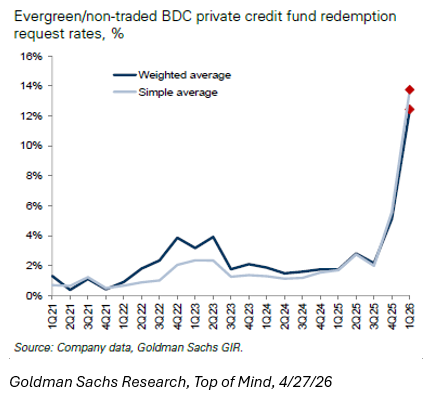
The real difficulty is that retail investors likely do not fully understand this market and therefore any hint of potential trouble causes them to seek an exit. The lack of liquidity is a feature they should have understood, and evidently the sales-oriented BDCs that are now faced with heavy redemption requests are realizing they have a major public relations problem. Private credit is intended for long-term investors who understand the risks inherent in this market and who are willing and able to stay the course. It is not a suitable market for retail investors trying to get a little extra yield from their bond portfolio, it is not a tactical or opportunistic way to diversify, and it is not meant for investors with regular or even occasional liquidity needs.
Are concerns about systemic risk valid? In our opinion, we do not believe the financial system is at risk of anything like the GFC. There are many reasons for this optimistic view:
- The vast majority of private credit is held by the large institutional investors who have always formed the nucleus of the investor base. These investors understand the risks and they do not expect liquidity from this segment. This reduces the “run on the bank” risk significantly.
- Forced sales are not likely to develop since redemption limits in retail-oriented BDC funds precludes fire-sale liquidation of loans.
- Most of the private credit market is not overly leveraged, with those using leverage generally capped around 2x at most according to Howard Marks of Oaktree Capital Management.
- Banks’ exposure to BDCs and private credit is estimated to be less than 5%, a very small percentage of overall bank lending, and the loans are largely held by large banks with over $10bn in assets.
- The interdependency of financial exposures that existed prior to the GFC, which exacerbated the extent of the crisis, are not present in the private credit market.
In closing, the private credit market is a viable investment choice for institutional, long-term investors who are able to lock up their funds for many years and understand the considerable inherent risk. In our opinion, we do not believe investors are well-served by Wall Street asset gatherers who put private credit into structures that are ill-suited for the inherent risks in this segment. It is not a suitable market for retail investors and not meant for investors with regular liquidity needs.
Firm Definition and Contact Information
Maple Capital Management, Inc. (MCM) is an independent SEC Registered Investment Advisor with offices in Montpelier, Vermont and Atlanta, Georgia. This commentary reflects the views of MCM and should not be considered to be investment or financial advice. MCM does not warranty these views and will not update this communication after the date of publication. Any mention of specific securities is done for illustrative purposes and the securities mentioned may or may not be held in client accounts. No assumption or assurance should be taken that securities mentioned will be safe or profitable investments. Past performance is not indicative of future results.
For further information, please contact David Bosworth at 1-802-229-2838 or at info@maplecapital.com. For further information about Maple Capital, including a copy of our informational brochure, please visit our website at www.maplecapital.com.
Disclaimer
This document is a general communication being provided for informational purposes only. It is educational in nature and not designed to be taken as advice or a recommendation for any specific investment product, strategy, plan feature or other purpose in any jurisdiction. This material does not contain sufficient information to support an investment decision and it should not be relied upon by you in evaluating the merits of investing in any securities or products. In addition, users should make an independent assessment of the legal, regulatory, tax, credit, and accounting implications and determine, together with their own financial professional, if any investment mentioned herein is believed to be appropriate to their financial situation and investment profile. Investors should ensure that they obtain all available relevant information before making any investment. It should be noted that investments involve risks, the value of investments and the income from them may fluctuate in accordance with market conditions and taxation agreements and investors may not get back the full amount invested. Both past performance and yields are not reliable indicators of current and future results. All information presented herein is considered to be accurate at the time of production, but no warranty of accuracy is given and no liability in respect of any error or omission is accepted.
Past performance does not guarantee future results. Diversification does not guarantee investment returns and does not eliminate the risk of loss.
www.maplecapital.com | 535 Stone Cutters Way, Montpelier, VT 05602 | Toll Free: 800.255.9946
The post Private Credit – July 2026 appeared first on Maple Capital Management.